

Helping Product Owners in several larger organisations, we keep seeing the same recurring challenge. We call it the Product Owner's trap.
Many Product Owners operate as component owners rather than owning a product. They start with clear intentions. They understand the role as value maximiser, they focus on delivering value, and they diligently set up their Product Backlog, their goals and their stakeholder relationships.
Yet the vital first questions often go unasked: "Am I truly the owner of a product that can deliver value?" and "How are we really going to validate our assumptions?" These questions reach beyond the mechanics of Scrum. They are about owning something that realises value when a customer engages with it. In the pursuit of perfecting the individual parts, the whole gets overlooked. Instead of cultivating value, the Product Owner ends up managing dependencies and loses sight of the broader objective.
The 3 V's: vision, value and validation
The challenge usually starts when a Product Owner grapples with the 3 V's. Understanding them shifts the mindset towards a product-led and value-driven approach, and away from a focus on components.
- Vision. The overarching goal of the product.
- Value. A focus on what delivers the most value to stakeholders.
- Validation. Regular assessment with stakeholders to confirm you are aligned.
The 3 V's are a critical stepping stone on the Product Owner's journey. They bridge the gap between delivering features and genuinely maximising value.
Visualising the dilemma: a Product Owner's scenario
Consider a bank. A customer applies for a mortgage, and the bank provides several services along the way: KYC verification, credit assessment, loan underwriting and so on. Each service is a product with its own backlog and its own owner.
The bank, though, is focused on organisational initiatives to improve its market position. For simplicity, say it has three: refining the mobile banking app (red), broadening customer service reach (green), and a more secure identity verification process (blue).
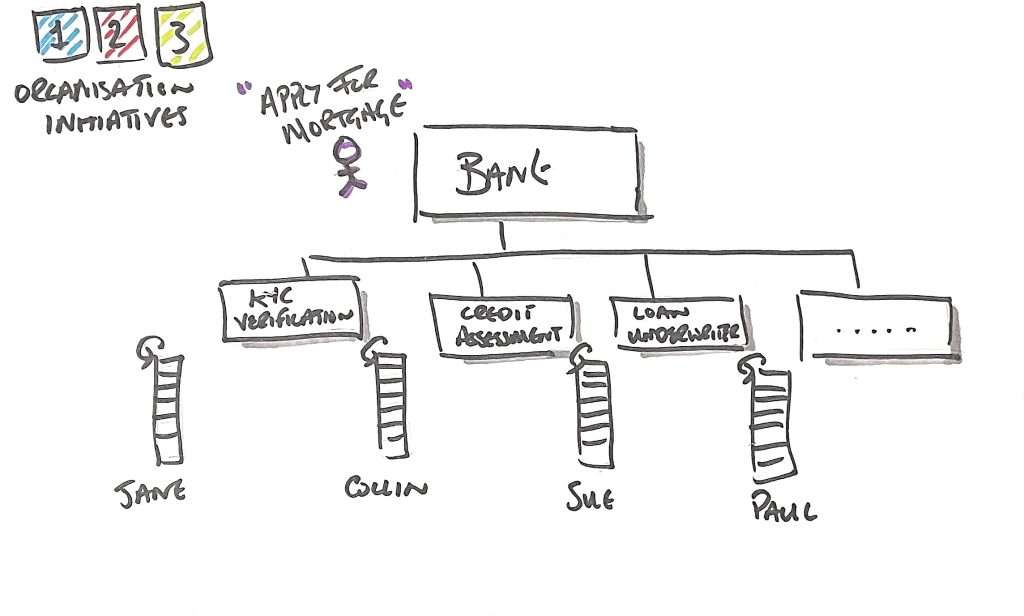
Now picture Colin, a Product Owner, asking me for help. The conversation goes like this:
- Colin: "Alex, I appreciate the coaching. I'm starting to understand Scrum and my role as Product Owner much better. Be a value maximiser. But there's an issue. I believe in the value of the red initiative for my product, but I need Sue, Paul and Jane's help to deliver it."
- Me: "Is there anything else?"
- Colin: "Yes. Sue is adamant about prioritising the blue initiative and insists her items are urgently needed from me and my team."
- We bring Jane into the discussion.
- Jane: "We understand where Colin is coming from, but our focus is the green initiative. And we need work from Colin's team, as well as Sue and Paul."
The conversation continues with Sue and Paul. Here is what we have:
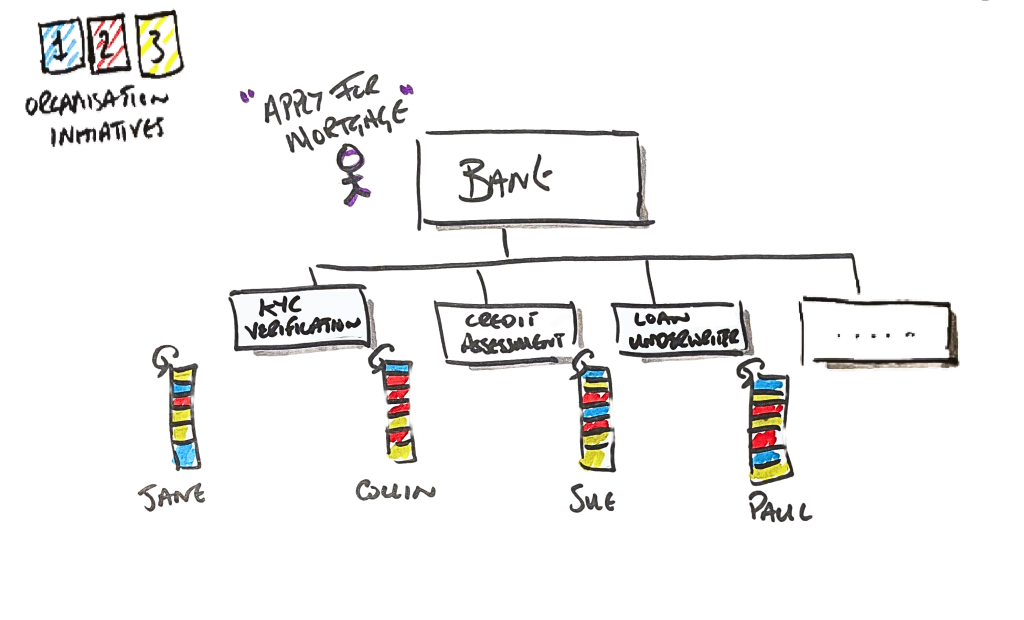
Now step back and trace a path through the red initiative alone, the one Colin brought to us at the start.
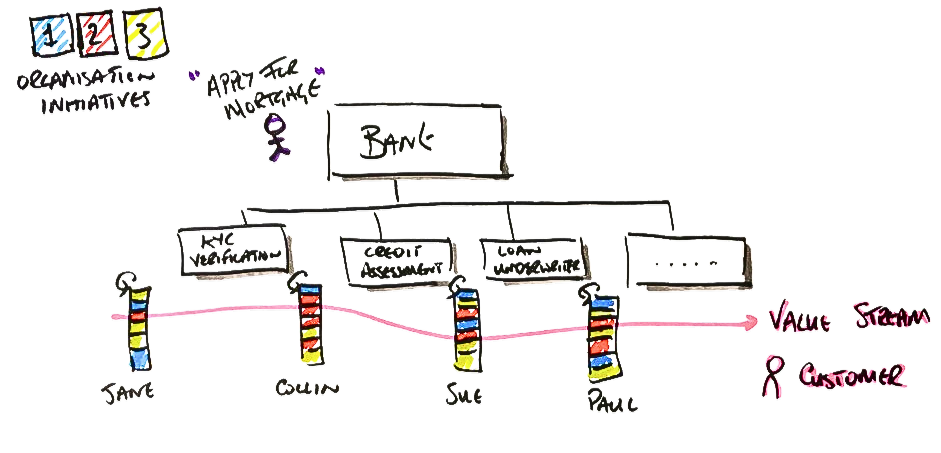
It runs through every current product backlog. That line is your real value stream. It is your customer's journey, and it shows what you should genuinely care about as a Product Owner.
Does this echo the reality in your organisation? It prompts the big question. Are you genuinely a Product Owner, or have you become a component owner, focused on output rather than end-to-end value?
Interestingly, the dilemma seems to bite less in smaller companies. Being closer to the customer seems to keep the focus naturally aligned with genuine product ownership.
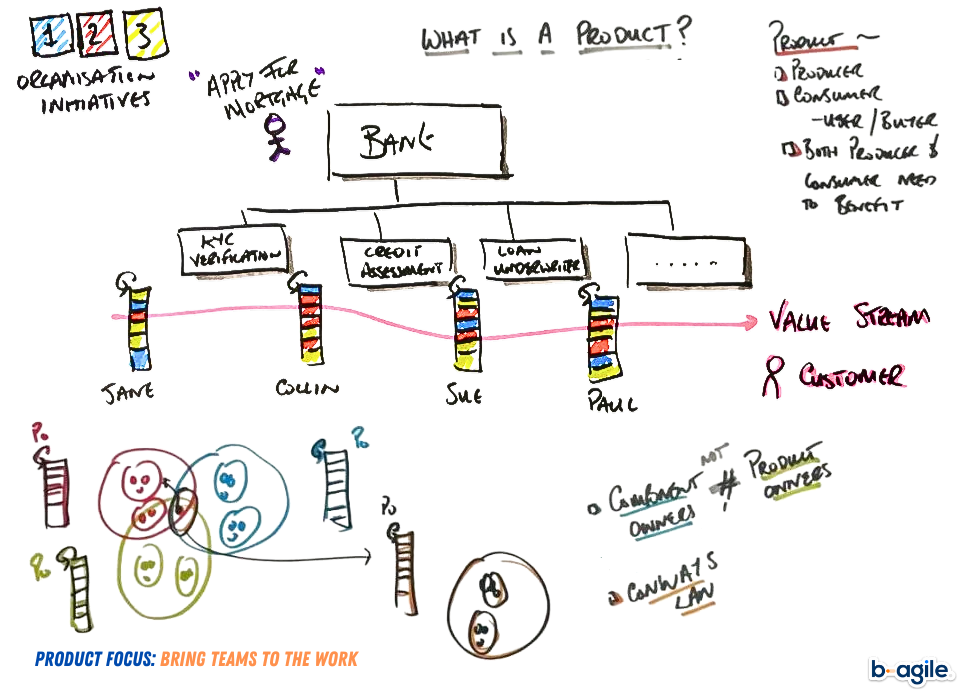
What is a product?
Let's establish a shared understanding. When we talk about a product:
- There is a producer and a consumer. The entity creating the thing, and the person or group who uses or buys it.
- It creates value. Its primary purpose is to solve a problem for the consumer and meet their needs.
- It can be physical or not. A tangible item, or an intangible service.
- It benefits the producer. Revenue, cost savings or societal benefit.
Defining your product accurately is not always easy. It has to be at the right level: not so broad that it becomes vague, not so narrow that it loses its value.
Consider buying a car. Do you buy an airbag? A steering wheel? Or a car? The airbag and the steering wheel are perfectly valid products in their own right, but they are components of the broader product. The car is what solves the consumer's transport problem.
How often do we find ourselves operating at the component level and failing to see the bigger picture?
The component trap: root cause and the way forward
Product Owners get trapped as component owners because of old ways of working and the organisation's communication structure, rather than a focus on delivering products and value for the customer. Conway's Law sums it up.
Three things contribute:
- Work is brought to the team, and the old project mindset persists. New methods are adopted, but the communication structure stays the same. The shift to a product mindset, with a holistic view of the product, never happens.
- The focus stays on output, such as the number of features, rather than outcomes. An output focus overlooks the real goal of tangible value for customers and the organisation, and reduces the impact of the work.
- The critical question is never asked. "What is our product? Am I delivering something that makes an organisational or customer impact?" Skip it and effort drifts away from product value, and the full potential of product ownership is never realised.
A motto that helps the shift: "Ignore your current set-up, and bring the teams to the work, not the work to the teams." Build teams around delivering value rather than preserving the existing workflow of component teams. It can spark self-organisation, with teams discussing the best formation to deliver value.
The collaboration that follows may not change the team structure at all, but it builds communication and unifies focus. Several teams may start to operate as one. It is a change that starts with a conversation and leads to realignment around delivering value.
Aligning the why: the collaborative role of the Product Owner
The Product Owner's role is about more than overseeing components. It is about aligning with the why and the vision, and creating a collaborative environment.
- Understand the why. The Product Owner connects stakeholders and delivery teams with the purpose and the goals, so everyone is aligned on meaningful outcomes.
- Foster collaboration. By creating a cooperative environment, the Product Owner enables stakeholders and delivery teams to work together on genuine value.
- Use tools and techniques as enablers. Impact mapping, user story mapping, specification by example, user stories and more. They drive collaboration and transparency between stakeholders and delivery teams.
- Guide towards value. Steer away from component thinking and towards end-to-end value and customer satisfaction.
Help with the shift to a product and value-driven mindset
Aligning focus and nurturing collaboration in a constantly changing product landscape is hard. Our Scrum.org Professional Scrum Product Owner course is built to help, guiding you towards a product mindset and the value-driven strategies that work in the modern marketplace. It covers:
- Understanding and applying the 3 V's. Defining and communicating the product vision, measuring and maximising value, and continually validating progress, including the Scrum principles and empiricism.
- Value over components. Recognising the value of a product over a project mindset, with techniques for Product Backlog management, release management and forecasting.
- Alignment with organisational objectives. Connecting business strategy, product vision, Product Goal and Sprint Goal.
- Collaboration and communication. Working effectively with stakeholders, customers and development teams, including how to communicate the strategy, vision and Product Goal.
- Practical tools and techniques. Exercises for driving alignment and collaboration, adapting to market change, and identifying the metrics that track value.
With an understanding of Professional Scrum and its complementary practices, the course gives Product Owners the tools and insight to shift towards a product and value-driven mindset, and a more entrepreneurial role in product management.

End note
Being a Product Owner has its challenges, but focusing on a few core principles makes a significant difference:
- Define the product. Understand its true value.
- Align with the why. Keep stakeholders connected to the overarching vision.
- Foster collaboration. Facilitate engagement across every party.
- Guide towards value. Prioritise genuine value over managing components.
Reflect. Take time to consider your role as a Product Owner and how you can live these principles.
If you want to explore these topics further, it would be great to see you on one of our Professional Scrum Product Owner courses.
Go deeper
Professional Scrum Product Owner (PSPO)
Put this into practice with the course that covers it in depth.
View the course