

As Professional Scrum Trainers we are asked about the responsibilities of a Product Owner more than almost anything else. The confusion usually comes from one of three places: being new to the role, misunderstanding the Product Owner's accountabilities, or expectations that were never aligned in the first place. The Scrum Guide is clear about what a Product Owner is accountable for. It deliberately leaves open how that accountability is fulfilled, and that freedom is where people get lost.
A Product Owner can take several stances to fulfil those accountabilities: Visionary, Collaborator, Customer Representative, Decision Maker, Experimenter and Influencer. Each one addresses a different aspect of delivering value and engaging stakeholders. Scrum.org's post on the stances of the Product Owner covers them well.
This post picks out six responsibilities that support the Product Owner's accountability. Along the way it addresses the misconceptions we see most often: Product Owners treated as solution designers, as go-betweens for customers and developers, or a Product Backlog treated as a task list rather than a strategic tool for delivering value.
If you want the wider picture first, start with What is Scrum? Uncovering its true essence.
Accountabilities and responsibilities are not the same thing
A quick clarification before we start:
- Accountabilities are the outcomes a person is ultimately answerable for. They define ownership and cannot be delegated.
- Responsibilities are the tasks and activities that support those accountabilities. They can often be delegated, but the accountability for their success stays with the owner.
The six responsibilities below are practical ways to fulfil the one accountability that matters: maximising the value of the product.
1. Understand your product
The first step to maximising value is genuinely understanding your product. That means:
- Knowing the problem the product solves and its core value proposition.
- Knowing who the customers are, what their key problems are, and how the product solves them.
- Recognising that the product serves two sides: consumers (end users) and producers (business stakeholders).
Tools and techniques
- Use the Business Model Canvas, Lean Canvas or Value Proposition Canvas to make your assumptions about the market and the product strategy explicit.
- Revisit those assumptions as the market moves, so the product stays aligned with customer needs and business objectives.
A personal tip
Many Product Owners end up managing a component rather than a true product. The tell-tale sign is a backlog full of dependencies and real difficulty delivering anything of value on its own. It usually comes from losing sight of the customer and the problem the product solves. Rethinking what the product is, and aligning delivery teams around it, unlocks far more value. There is more on this in Escaping the Product Owner's trap.
2. Set the vision
A clear vision inspires the team and gives long-term direction. The Product Owner articulates that vision and makes sure the Product Goal serves it.
Key responsibilities
- Define the why behind the product. Why does it exist? Why does it matter to customers and stakeholders?
- Use creative techniques such as the Innovation Games Product Box or a product vision template to shape and communicate the vision.
- Revisit and adapt the vision as the market and the organisation's goals change.
3. Plan strategically
Strategic planning turns the vision into actionable steps, with continuous adaptation and measurable outcomes built in.
Key responsibilities
- Build a product roadmap using techniques such as impact mapping and user story mapping to align priorities and surface dependencies.
- Define measurable Product Goals, so each increment moves the product towards them and validates an assumption.
- Adapt the roadmap as you learn from feedback. Aim for outcomes rather than adherence to a plan.
- Build in feedback loops that tell you when to release, so value is realised as early as possible.
- Facilitate the conversations that align the team and stakeholders on the Product Goal.
- Act as the bridge between technical teams and business stakeholders, building mutual understanding.
- Keep progress visible with product walls or dashboards. Transparency builds trust.
4. Be budget aware
A Product Owner needs to understand the budget to maximise value, and to keep the relationship with stakeholders collaborative and adaptable.
Key responsibilities
- Know the cost of a Sprint, so you can forecast what a budget buys and have honest conversations with stakeholders about priorities.
- Watch the innovation rate, keeping a balance between new capability and maintenance so delivery is sustainable.
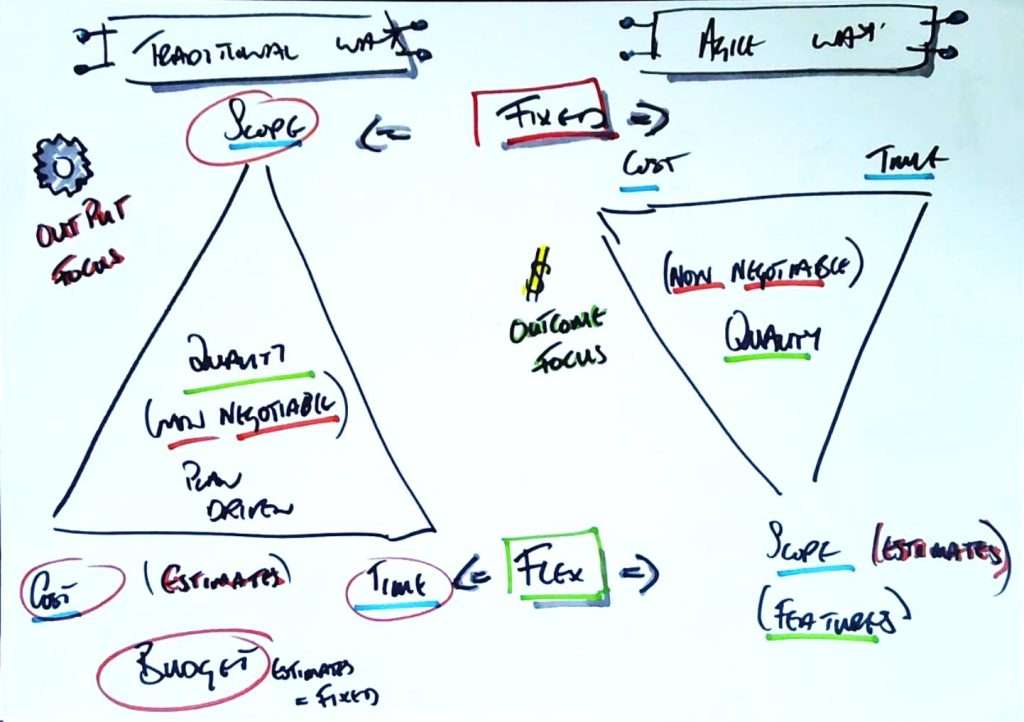
- Align budgeting with agile principles. Focus on outcomes rather than outputs, and work with stakeholders on budgets that allow for collaboration and adaptation.
- Encourage agile contracts, such as fixed price with flexible scope, so teams can iterate on what they learn. Simon Brown's contract models in an agile world is a good starting point.
- Reflect regularly on progress. Propose more budget if it is warranted, or close the contract early if the outcomes are already achieved.
- Factor the total cost of ownership, including technical debt and maintenance, into prioritisation decisions.
5. Manage stakeholders
Stakeholder management keeps a diverse set of needs aligned with the product's vision.
Key responsibilities
- Engage every stakeholder group, internal (developers, governance) and external (customers, partners), as their influence and interest change.
- Run feedback loops such as the Sprint Review in a way that produces insight you can act on.
- Map relationships and influence with a tool such as the stakeholder radar.
- Write down a stakeholder strategy: who you communicate with, through which channels, and what outcome you want from each.
- Communicate well. It is the backbone of the role. Collaboration with the Scrum Team and with stakeholders is what keeps everyone aligned and delivery on track.
6. Manage the Product Backlog well
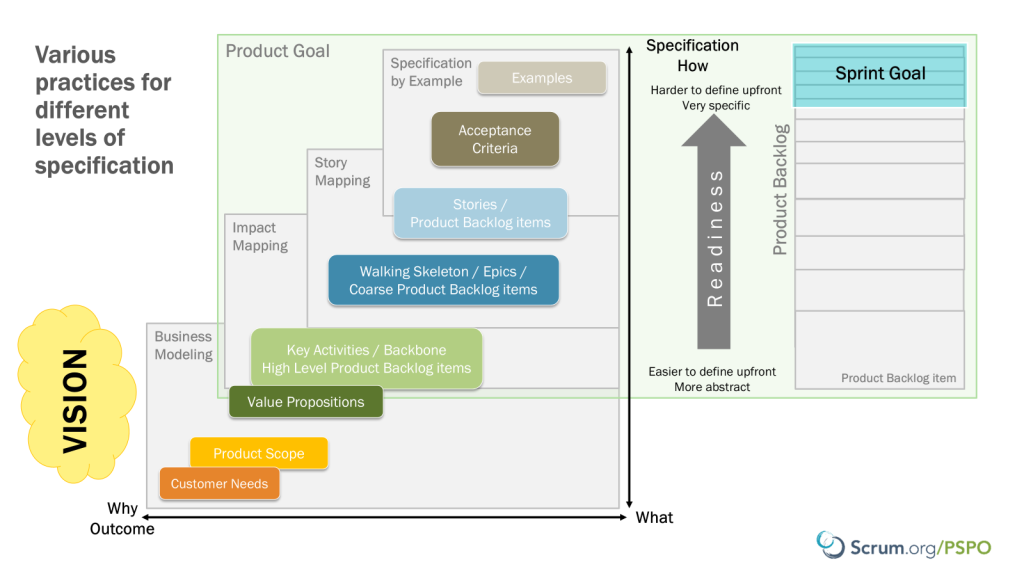
Product Backlog management keeps all work aligned with the Product Goal, and keeps it transparent, ordered and actionable. Items at the top are refined: specific, small and ready for the team to finish within a Sprint. Items further down are more abstract, placeholders for conversations still to come. Refinement is broader than the backlog itself. It includes the product vision and the Product Goal, which in turn shape the backlog, and it continues as the team learns.
Key responsibilities
- Create and maintain a transparent Product Backlog aligned with the Product Goal.
- Define and order items so the most valuable work is clear.
- Let the backlog evolve with stakeholder feedback and market change. Refinement is continuous: large, abstract items are broken down into smaller, actionable ones as they move towards the top.
- Work with the Scrum Team to refine items into a ready state, small enough to complete within a Sprint. That includes the items that shape the backlog, the vision and the Product Goal, so they evolve as priorities change.
In summary
The Product Owner role is dynamic and demanding. It asks for a balance of strategy, collaboration and adaptability. The Scrum Guide defines the accountability. These six responsibilities are how you fulfil it:
- Understand the product.
- Set the vision.
- Plan strategically.
- Be budget aware.
- Manage stakeholders.
- Manage the Product Backlog well.
Focus on these and you maximise value, align your team, and navigate the complexity of agile product management with confidence.
To go deeper into the purpose of the role, read Unmasking the Product Owner accountability. For a team exercise, try our Scrum accountabilities exercise.
Ready to build these skills properly? Our Professional Scrum Product Owner course is where to start.
Go deeper
Professional Scrum Product Owner (PSPO)
Put this into practice with the course that covers it in depth.
View the course