

When we ask people in our training sessions "What is Scrum?", their explanations usually focus on the mechanics: the elements of the framework and its iterative approach. It is like asking about a power tool and being told about its inner workings. What we are really interested in is the tool's purpose, its usefulness, and how to use it properly.
Yet when people are asked about Scrum, they start describing its internals.
This post gives a high-level overview of what Scrum is. We touch on the mechanics, but more importantly we get at its essence. Understanding Scrum means grasping not only its rules but its purpose: how it serves product development, enables business agility, and helps us live the Agile values and principles.
So let's look at the key elements of Scrum with a focus on the purpose behind the rules: continuous improvement, self-management and effective problem-solving in complex environments.

For the common myths about Agile and Scrum, see Agile and Scrum: unravelling the misconceptions.
Scrum in a nutshell
Scrum is a lightweight framework designed to enable business agility, helping people, teams and organisations create value through adaptive solutions to complex challenges. Like the basic rules of a game, it gives you a guiding framework without prescribing exactly how to master it. Its structure is straightforward. Its impact is substantial, grounded in experiential learning and decisions based on tangible results.
At its core, Scrum is about simplicity and intentional incompleteness. Applied correctly, it maximises value and manages risk in product development.
When a team is genuinely practising Professional Scrum, we expect to see:
- Continuous improvement
- Self-management
- A valuable, usable Increment every Sprint
- A value-driven, product focus
- High engagement with stakeholders
These are the signs of real alignment with Scrum's principles and values.
To understand Scrum deeply, the Scrum Guide is essential. It defines Scrum as "a lightweight framework that helps people, teams and organizations generate value through adaptive solutions for complex problems".
The core elements of Scrum
A quick recap of the mechanics, as the Scrum Guide sets them out:
- 3 accountabilities: Product Owner, Scrum Master and Developers.
- 5 events: Sprint, Sprint Planning, Daily Scrum, Sprint Review, Sprint Retrospective.
- 3 artefacts: Product Backlog, Sprint Backlog, Increment.
- 3 commitments: Product Goal, Sprint Goal, Definition of Done.
Each element is crucial to enabling empiricism and self-management, both vital to Scrum's effectiveness. The events, for instance, are formal opportunities to inspect and adapt.
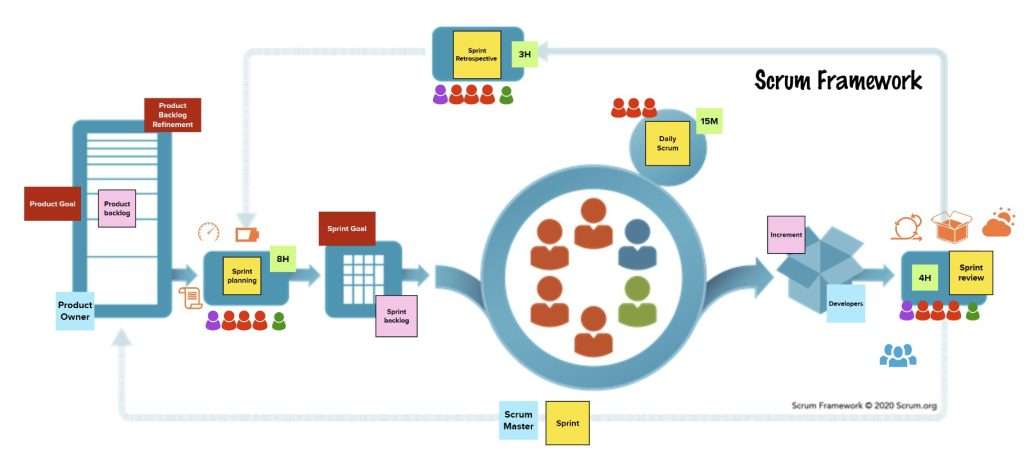
Two questions come up constantly about the framework: the event timeboxes, and Product Backlog refinement. Let's clear those up.
Events are timeboxed
Every Scrum event is timeboxed. Each has a maximum duration with a clear end point, though participants can finish early once the event's objective is achieved. That keeps the events focused, committed and effective.
For a one-month Sprint the timeboxes are:
- Sprint Planning: 8 hours
- Daily Scrum: 15 minutes
- Sprint Review: 4 hours
- Sprint Retrospective: 3 hours
For shorter Sprints the timeboxes shrink accordingly, except for the Daily Scrum.
Product Backlog refinement is an activity, not an event
Product Backlog refinement is a continuous, crucial activity carried out by the Scrum Team. It makes sure Product Backlog items are clearly understood, refined and prepared for upcoming Sprints.
Items at the top of the Product Backlog are brought to a ready state, meaning the team clearly understands their purpose and can complete them within a Sprint.
That ongoing refinement underpins Scrum's focus on business agility. It lets the team respond to complex challenges and keep delivering valuable, usable Increments aligned with stakeholder needs.
The principle behind Scrum: empiricism
Scrum is grounded in empiricism: knowledge comes from experience, and decisions are based on what is observed. A Scrum Team is in a continuous cycle of learning and adapting, rooted in real-world feedback.
The three pillars of empiricism guide that cycle:
- Transparency. We all know what is going on.
- Inspection. We continuously check the work as we do it.
- Adaptation. It is fine to change tactical direction on the insight gained from inspection.
Empiricism is the catalyst for ongoing improvement. It lets the team adapt quickly to customer feedback, evolve its methods and navigate risk. It is pivotal to accelerating product development and delivery, and to improving value and predictability.
The Scrum values: the lifeblood of the framework
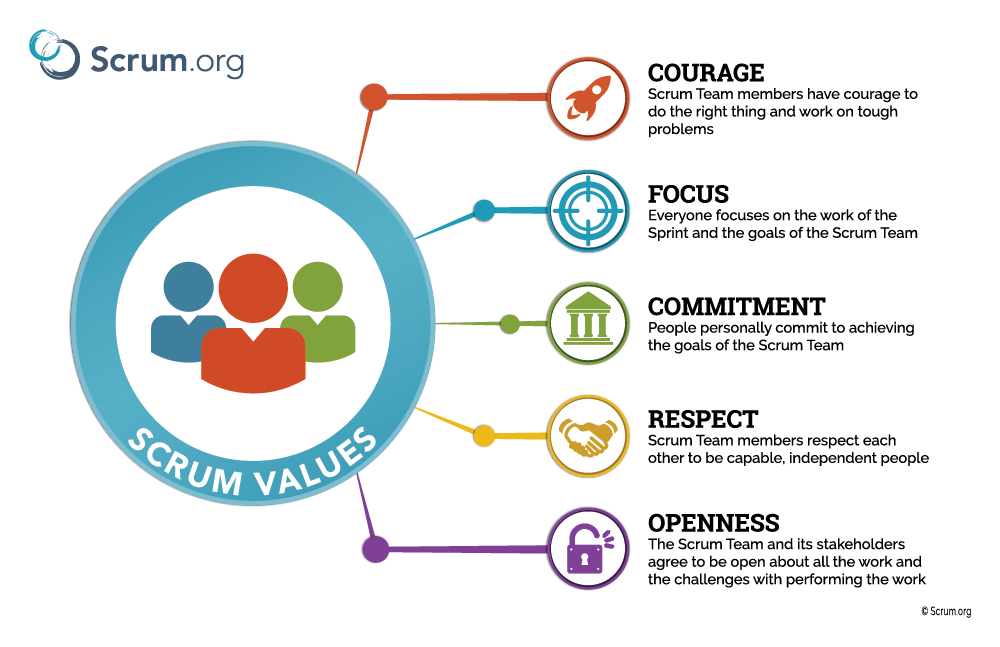
Central to Scrum are its values: courage, focus, commitment, respect and openness.
They are not mere words. They are the lifeblood of Scrum and what makes it effective. Without them, Scrum becomes a mechanical process with no spirit.
The Done Increment: the essence of Scrum
At the heart of Scrum is the Done Increment. It is non-negotiable, and new teams often find it challenging. A Done Increment every Sprint is the mark of a team living Scrum's principles and committed to delivering value.
- Empirical process control. The Done Increment reflects true progress, as a thermostat's reading is essential to regulating temperature.
- A focus on quality and value. It shifts the team towards delivering high-quality, valuable Increments that meet the Definition of Done.
- Transparency and trust. A consistent Done Increment shows real progress and aligns the expectations of team and stakeholders.
A team that does not achieve a Done Increment is not fully practising Scrum. It is a signal to reassess the approach and embrace the framework's core principles.
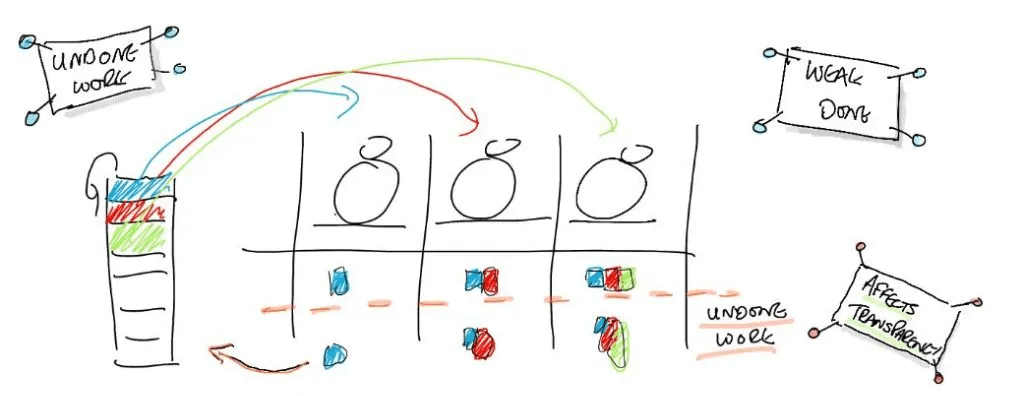
For more on the Done Increment and its effect on delivery and team performance, read Product Owners want a perfect Definition of Done. For a practical way to create one, read Definition of Done: where to start.
Scrum: the thermostat for product development
Scrum's focus on the Done Increment makes it a thermostat for product development:
- An empirical approach. As a thermostat uses temperature readings to adjust the environment, Scrum uses the Done Increment to guide decisions, so they are based on actual product progress and value.
- A value gauge. The Done Increment is more than progress. It measures the product's value to customers, like checking the temperature to see whether an adjustment is needed.
- Informed decisions. The Increment is not just for tracking the team. It informs the big decisions. Continue as is, change direction, or stop? Like reading the thermostat to decide whether you need more heating or cooling.
In short, the Done Increment helps a team make informed, value-based decisions on what is observed, just as a thermostat regulates a room on the temperature it measures.
Self-management and continuous improvement
Implemented well, Scrum fosters self-management and continuous improvement. Both are woven into the framework, mainly through the events and the accountabilities.
- Self-management within boundaries. The events and accountabilities give clear boundaries. Understood and implemented correctly, they create space for the team to self-organise, make decisions autonomously and own its work. Misinterpret or misuse them and self-management breaks down, undermining the essence of Scrum.
- Continuous improvement through the events. Each event is designed as an opportunity to inspect and adapt. Misunderstand or misapply them and the potential for improvement shrinks dramatically.
Understanding and applying the elements properly is what creates a true Professional Scrum environment, where self-management and continuous improvement are practical realities rather than ideals.
A mirror, not a magic wand
Scrum is not a magic solution that fixes everything. It is a revealing mirror, reflecting the true state of an organisation and its teams. It shows both the strengths and the areas needing improvement. Embracing Scrum means accepting its insights and challenges head-on, and resisting the temptation to change Scrum itself because it exposes uncomfortable truths or demands significant change.
- A catalyst for business agility. Scrum drives the adaptability and responsiveness that business agility needs.
- Dependent on organisational commitment. Success hinges on embracing change and learning from failure.
- Focused on sustainable improvement. Scrum emphasises long-term growth and adaptability.
Conclusion: Scrum is more than a framework
Understanding Scrum is like understanding the rules of football. Knowing the rules is relatively simple. Mastery comes from applying them to build an effective, successful team.
Scrum's structure is straightforward. Its real strength is unlocked through applying its principles and values, with an awareness of the many complementary practices that can be combined with it to maximise value.
Implementing Scrum merely as a framework misses the larger point. Done properly, it is a powerful catalyst for business agility and quality. It is a set of guidelines that foster a more responsive, innovative and effective way of working, and the pursuit of improvement never ends, just as football strategies, skills and teamwork keep evolving.
To build your proficiency, we run a range of Scrum.org courses:
- Professional Scrum Master. For those aiming to be effective Scrum Masters, with the skills to guide and support a Scrum Team.
- Professional Scrum Product Owner. For Product Owners, on maximising value and excelling at product management within Scrum.
Related reading: What is a Scrum Master? The true role revealed.
Go deeper
Professional Scrum Master - AI Essentials (PSM-AI)
Put this into practice with the course that covers it in depth.
View the course