

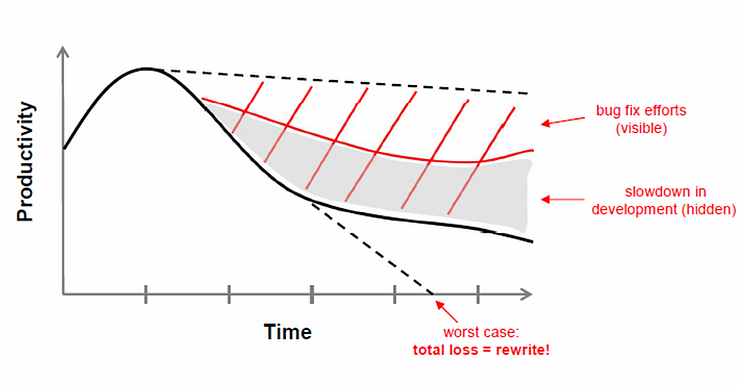
Technical debt is a term coined by Ward Cunningham, one of the authors of the Agile Manifesto. It likens problems in code to financial debt: it is fine to borrow against the future, as long as you pay it off. Technical debt has visible and invisible elements. Businesses usually monitor the bugs. It is the invisible element that does the damage, and it can leave a product destined for the scrap heap.
Understanding and managing technical debt is crucial to business agility, and to the quality, performance and long-term viability of your products. This post covers what it is, what it costs, how to spot it, and what you can do about it.
What is technical debt?
Technical debt is the set of compromises made in software development that speed up delivery now but create extra work and complexity later. Like financial debt, borrowing today means paying interest tomorrow.
What causes it?
The causes are many and usually come from the development process itself:
- Rushed development. Under pressure to hit a deadline, teams take shortcuts and code quality suffers.
- Lack of collaboration. Poor communication between developers, testers and other stakeholders leads to misunderstanding and poor design decisions.
- Inconsistent coding standards. Without clear, consistent standards the codebase becomes messy and hard to maintain.
- Obsolete technology. Outdated technologies and libraries make the codebase rigid and hard to update.
- Insufficient testing. Thin testing leaves hidden defects that turn into debt over time.
- Ignoring refactoring. Failing to improve the code regularly lets inefficient, tangled code build up.
- Business priorities. New features are prioritised over code quality, and the compromises become debt.
- Inadequate skills. A team without the necessary skills or expertise produces code that is not up to standard.
- Ignoring feedback. Feedback from code review is not acted on.
Types of technical debt
Knowing the types helps you identify and address the specific challenges your organisation faces:
- Deliberate debt. Incurred intentionally, often to meet a deadline or a business need. A calculated risk, taken on the understanding it will be paid back.
- Accidental debt. Incurred unintentionally through lack of knowledge, oversight or unforeseen complexity: coding errors, poor design choices, outdated documentation.
- Outdated debt. As technology evolves, parts of the codebase become obsolete or incompatible with newer technology and need updating to stay maintainable.
- Testing debt. Skipping or skimping on testing leaves hidden defects and vulnerabilities. It is costly to fix later, especially once it reaches customers.
- Design debt. Compromises in architecture or design that limit scalability, maintainability or performance. Usually takes significant refactoring to resolve.
- Documentation debt. Incomplete or outdated documentation that hinders future development and makes it hard for new team members to contribute.
- Tooling debt. Outdated or inefficient tools that slow development, testing and deployment. Investing in modern tooling pays back in efficiency and quality.
Recognising and categorising technical debt lets a team prioritise its efforts and apply targeted strategies to reduce and manage it.
What does technical debt cost?
First, the cost of change from a technical perspective. The red waterfall curve assumes big design up front, where the design is perfected before construction. That is unrealistic in the high-novelty, complex adaptive domain of software delivery, where a design is only validated through working, releasable software.
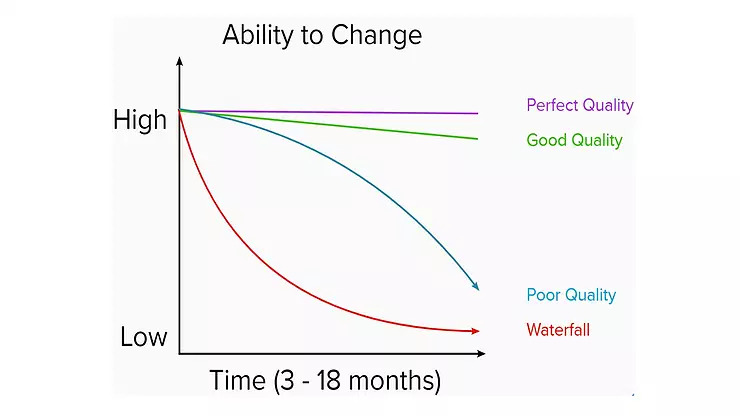
Technical debt has profound effects on the development process, product quality and business success.
An unreasonable cost of ownership
The most common scenario we see is a growing cost of ownership. The impact is low at first, then builds momentum. Maintaining, supporting and adding features to the product becomes more complex and more expensive over time, and the cumulative cost of ownership climbs.
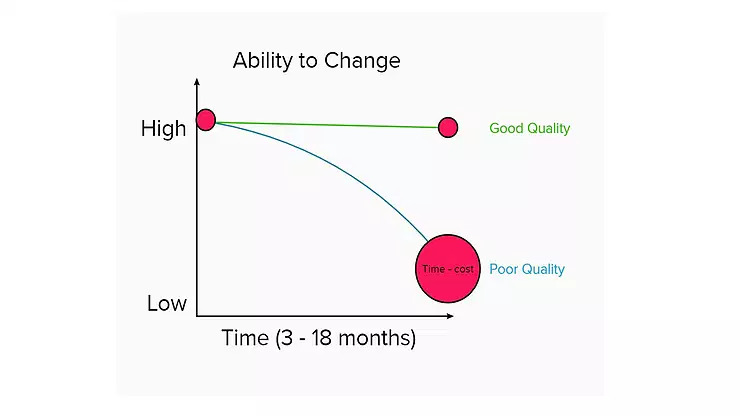
If we built feature A in month 1, and the same feature in month 18, with good quality and a development team working at a sustainable pace, the cost of the two would be comparable.
With high technical debt, where the team is fighting the design, costs grow rapidly over time. That means:
- The cost, or difficulty, of change increases, eventually to the point of unmaintainability.
- The ability to respond to customer needs decreases, and customers become extremely unhappy.
- Predictability decreases. Estimating effort and complexity gets harder, transparency falls, and trust suffers.
The signs of an unhealthy product
Recognising the signs is the first step. See which of these you recognise:
- A weak Definition of Done. One that is poorly defined or does not represent quality for the product. Knowing what Done means is crucial to maintaining quality. See why Product Owners want a perfect Definition of Done.
- Slowing productivity. Longer cycle times to add similar-sized features.
- Stressful releases. Teams go into crunch mode: long change windows, scripts run by hand, manual deployment and configuration, incident investigations and defect fixes.
- Untouchable applications. Ageing libraries and unnecessary dependencies make applications the team is scared to touch.
- Growing incident investigation time. More and more time spent investigating incidents and fixing defects.
- Low automated testing. No extensive test suite, so testing is repetitive, slow, manual and error-prone.
- Fragile, tightly coupled components. Design principles violated, duplicated code, tangled architecture, needlessly complex dependencies.
- Lack of automation. Missing test, build and deployment automation, and anything else done by hand that could be automated.
- Long feedback loops from continuous integration. Slow build, test and deploy.
- Slow, ineffective tools. Tools that hinder rather than help.
- Long-lived branches. Merge hell and increased delivery risk from late integration. See Branching is killing your delivery.
- Missing or outdated technical documentation. Important documentation that is absent or stale.
- Unnecessary technical documentation. Documentation maintained long after anyone needs it.
- Insufficient test environments. Missing or too few, delaying delivery or reducing quality.
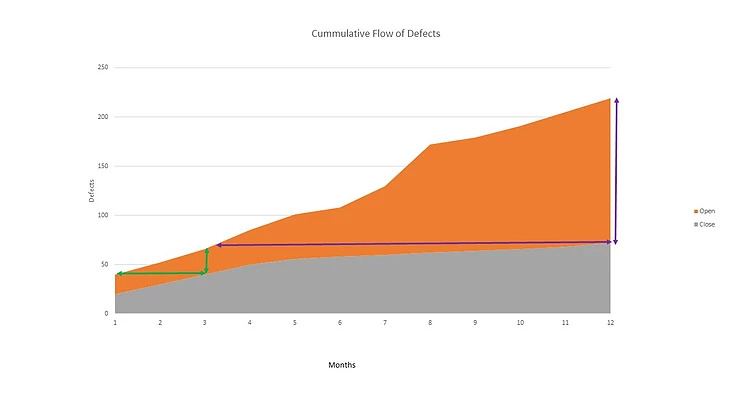
- Defects trending up. Great Scrum Teams fix bugs as they find them and never let them accumulate. If open or escaped defects trend upwards, quality is falling and debt is rising. In the cumulative flow diagram below, the average number of open defects (vertical) and the average time to fix (horizontal) both grow over time.
Who suffers in this vicious circle?
The consequences reach every stakeholder in the organisation:
- Customers face defects, missing features and poor service, and satisfaction falls.
- First-line support raises more incidents, increasing the load on operational support teams.
- Poorly designed products are more complex than they need to be, with more dependencies, more infrastructure, more development time and more support time.
- The organisation, its teams and its leadership get bad publicity from defects, delays, security issues or outages.
- Development teams have to live with other developers' bad work, leading to attrition and lost talent.
- As it worsens, customers complain about slow delivery, which increases the pressure to take shortcuts, which increases the debt.
Your options for dealing with it
By the time an organisation is paying attention, none of the options are good. Recognising the problem and making it transparent is still the start of improvement:
- Do nothing. It gets worse.
- Replace or rewrite the software. Expensive, high risk, and it does not address the root cause. Rinse and repeat in about two years. Some organisations have replaced legacy systems successfully by adopting agile ways of working and focusing on continuous improvement.
- Stop creating more debt. Invest systematically in incremental improvement. This takes a commitment to quality, and investment in the training, tools and processes that support good practice.
- Make the debt transparent. Use tools such as SonarQube, test coverage, dependency analysis and static analysis to make it visible and manageable.
For a broader approach to finding where the waste is, read Value stream mapping: your answer.
Empower your teams to keep the product off the scrap heap
Technical debt is a major barrier to delivering value and achieving business agility. Equipping your teams with the right knowledge, tools and support is how you overcome it.
Knowledge through training
- Professional Scrum Master. Educates Scrum Masters and leadership on the impact of technical debt and how to manage it. Learn more.
- Professional Agile Leadership with Evidence-Based Management (PAL-EBM). Teaches leaders to use empiricism to set and achieve strategic goals, manage unknowns and complexity through experimentation, and stay customer-centric. Evidence-Based Management focuses on outcomes rather than outputs. Measuring key value metrics in key value areas such as time to market and ability to innovate lets leadership align effort with business goals. Learn more.
- Professional Scrum Product Owner. Helps Product Owners understand technical debt and its impact on delivering value and product success. Learn more.
Support through coaching, mentoring and internal practice
- Internal practices. Build a culture of continuous improvement through communities of practice, coding dojos, pair programming and mob programming. They encourage collaboration, knowledge sharing and skill development, all essential to managing and reducing technical debt.
- External support. Reducing technical debt takes more than training. Our coaching, including workshops, pairing, coding dojos and mentoring, helps teams build technical practices into their daily work. We draw on extensive experience to shape a hands-on programme around your team's needs, building a culture of quality and innovation where technical debt is transparent, manageable and continuously reduced. Contact us to find out more.
Invest in both education and support and you create an environment where technical debt stays visible and keeps shrinking, which is what secures the long-term success of your products.
Conclusion
Technical debt is a complex challenge with far-reaching effects on product development, quality and long-term success. It is not just a development issue. It affects customers, support teams, the organisation and the reputation of the product.
The key takeaways:
- Recognise the signs early. Awareness of the symptoms allows timely intervention before more debt accumulates.
- Understand the impact. Technical debt slows development, increases cost and jeopardises quality. It is not just a code issue. It limits the agility of the whole business.
- Strategise and act. The options run from doing nothing, and watching it worsen, to systematic investment in improvement. Making debt transparent with tools like SonarQube, test coverage and dependency analysis is part of a comprehensive strategy.
- Invest in continuous improvement. Regular refactoring, coding standards, collaboration and modern tools keep technical debt in check.
- Use professional support. Technical agile coaches, like ours at b-agile, bring the expertise and support to reduce technical debt and enable business agility.
Technical debt is not necessarily evil. Sometimes it is a strategic choice. But like financial debt it must be managed wisely. Ignore or mishandle it and the product is headed for the scrap heap. Understand it, make it transparent and manage it proactively, and it becomes an opportunity for continuous growth and improvement.
To build the understanding your Scrum Masters and leaders need, start with our Professional Scrum Master course.
Go deeper
Professional Scrum Master - AI Essentials (PSM-AI)
Put this into practice with the course that covers it in depth.
View the course