

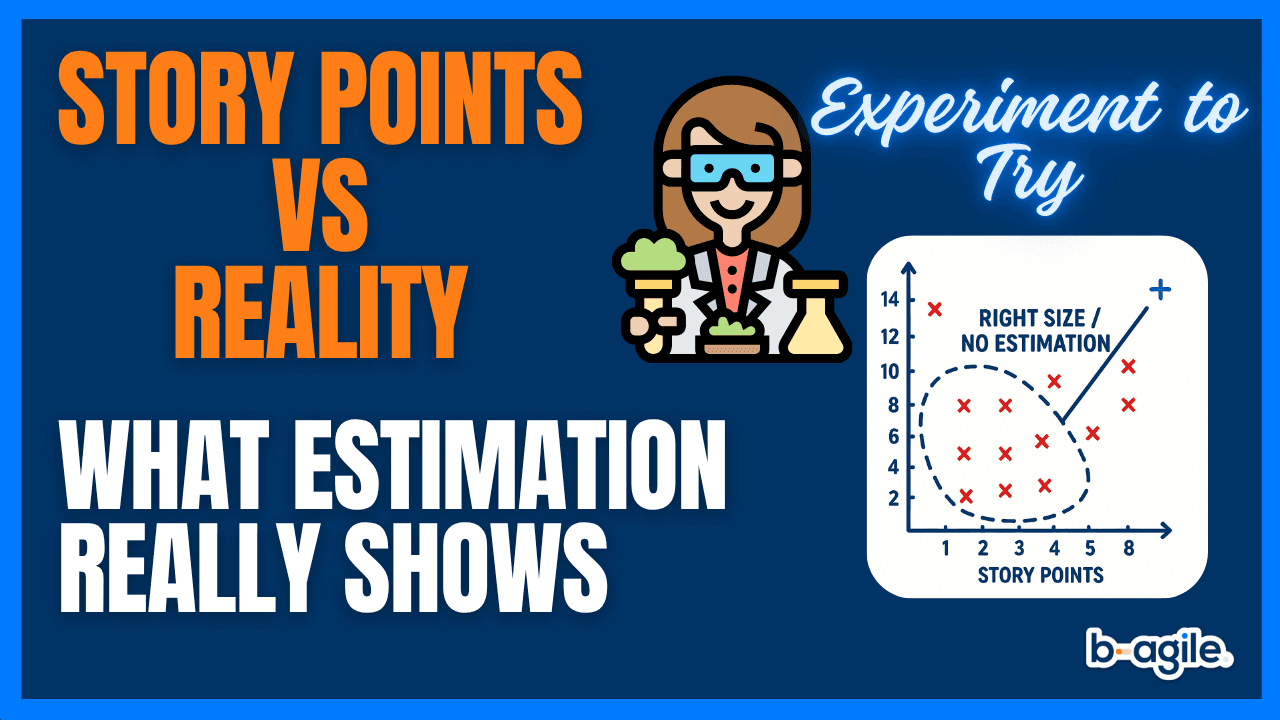
Maybe your story points and estimates are… pointless?
This is the next step in our estimation series. In the last post, Still using velocity? Make it useful again, we looked at how combining velocity with uncertainty shifts the conversation away from false certainty.
Now we go a step further, because velocity alone is not the answer either. The real shift is moving from estimation debates to data-driven predictability, using flow metrics like cycle time and throughput to focus on value instead of guesses.
Try this simple experiment
Here is what we ask teams to do:
- Track the story point estimate for each Product Backlog item.
- Track how long it actually took, its cycle time.
- Plot them side by side.
That is it.
At first it all seems to line up. A 2-point item takes two days. A 1-point item takes one day. Then someone says the dreaded line: "A story point equals a day."
It feels neat. Predictable. Like maybe this whole estimation thing actually works. And just like that, relative sizing slips back into absolute estimation.
But you keep tracking. A 1-point item takes six days. A 5-point item finishes in two. A 13-point item blows up completely.
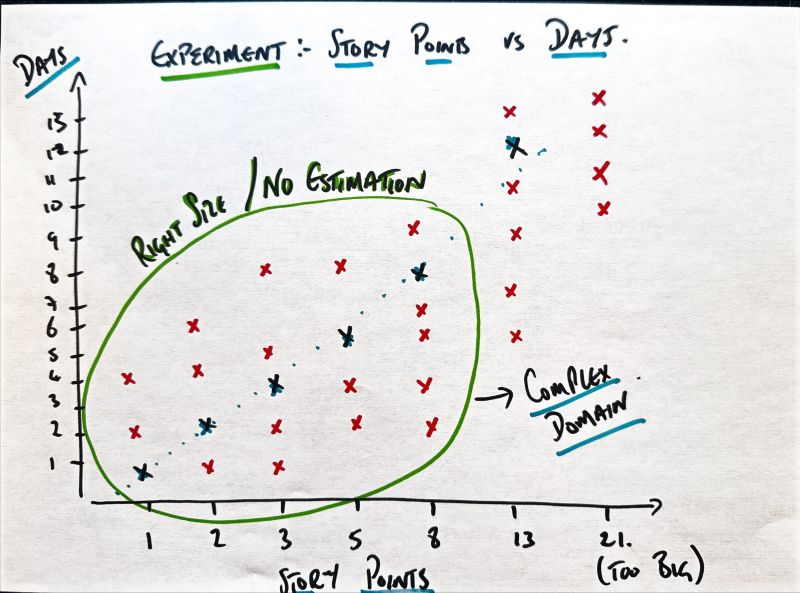
The pattern breaks. That is when the lightbulb goes on.
You cannot beat complexity with precision
This is not about bad estimation. It is about working in a complex space. Surprises happen. Dependencies emerge. Work changes shape as you learn.
You are seeing the cone of uncertainty from the previous post in action: our ability to predict gets worse the further out we look, especially for larger, more complex items. The bigger the item, the greater the variation. The more unknowns, the more risk.
That is why estimates fail when you use them to predict.
What the data shows
When teams run this experiment, a few things stand out:
- We work in a complex domain. Unknowns and surprises are normal.
- Some large items turn out to be quick, and some small ones take much longer.
- Teams often notice a pattern: a certain number just feels too big.
- There is no rule, but many teams find that items above 5 to 8 points get messy, risky and unpredictable.
- The number differs for every team, but the pattern shows up again and again.
It is not about chasing precision. It is about seeing complexity and using size as a signal, not a certainty.
It is not about points. It is about the conversation.
Story points, T-shirt sizes, hours. It does not matter. Estimation techniques are tools for starting the right kind of conversation:
- What are we building?
- What might trip us up?
- How confident are we?
- What is the risk?
That is the point. Not the number. Not the size. The shared understanding.
Some techniques do facilitate better conversations, but only when they are used properly and with purpose.
Right-size the work
Once a team spots the pattern it lets go of the point debates and focuses on breaking work down so it is:
- Clear enough to talk about.
- Valuable enough to deliver.
- Small enough to finish in a Sprint, or in a few days.
This is when estimation fades. Once the work is the right size for the team, there is nothing more to discuss. You get on with building it.
The team might use something as simple as a quick Roman vote, thumbs up or down, to decide whether an item is small enough to bring into a Sprint. Or it might keep using planning poker to make sure everyone feels the item is ready and the right size.
Either way, it is not about the number. It is about shared confidence. If the confidence is not there, the team asks how to break the item into smaller, valuable deliverables.
From estimation to flow
Instead of trying to control complexity, teams start to measure it. They look at:
- Cycle time
- Lead time
- Throughput
They use real delivery data to guide the next step. The result:
- Fewer debates
- Better predictability
- More value delivered
Not because they estimate better. Because they work better.
Help your team see it for themselves
This is not something to preach. It is something to try.
Run the experiment. Share the data. Let the team reflect.
When they see it for themselves, the mindset shift sticks. And estimation becomes what it was always meant to be: a conversation, not a commitment.
Want to go deeper into flow-based forecasting? Read DIY: when will it be done?, a hands-on guide to forecasting with your own flow data.
Earlier posts in the series
- Agile estimation isn't broken. But the thinking might be
- Velocity. It's not what you think it is
- Still using velocity? Make it useful again
We dig into this shift on our Professional Scrum Master and Professional Scrum Product Owner courses, where the focus moves from output and estimation to outcomes and value. To bring flow, data and predictability into your team's way of working, start with our Mastering Kanban lab.
Go deeper
Mastering Kanban
Put this into practice with the course that covers it in depth.
View the course