

When I hear teams talk about Kanban, I am reminded of The Princess Bride. Vizzini keeps exclaiming "Inconceivable!" until Inigo Montoya finally says: "You keep using that word. I do not think it means what you think it means."
Much like Vizzini's use of "inconceivable", teams often misuse the words Kanban, Scrum and Agile. When someone says "We're doing Kanban!" and their actions say otherwise, I have my own Inigo Montoya moment. It is a red flag that the adoption is incomplete or misunderstood. This post walks through the most common red flags and what to do about them.
The focus here is understanding and applying Kanban. If the same confusion exists around Scrum in your organisation, read Agile and Scrum: unravelling the misconceptions too.
The red flags of incomplete Kanban adoption
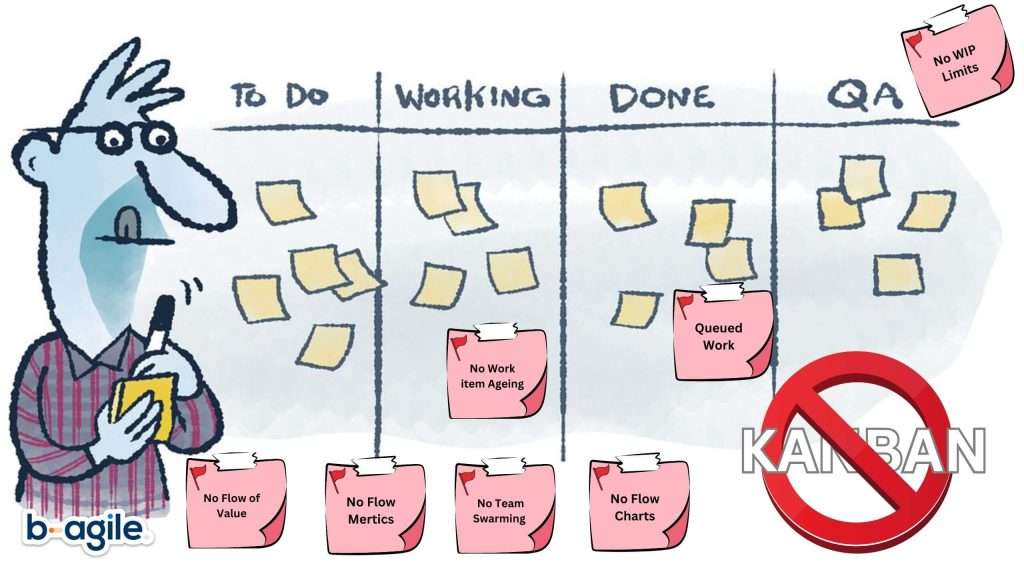
Before the practices and metrics that make Kanban effective, here are the signs that a team has not fully embraced it:
- A board without policies. A board with no work in progress (WIP) limits and no explicit policies is not Kanban. WIP limits create a pull system, and that is what improves both flow and visualisation.
- Ignored or unused metrics. Kanban is more than visualising tasks. Flow metrics such as cycle time and throughput give you transparency and a basis for improvement.
- Neglected charts. Cumulative flow diagrams and cycle time scatterplots are not decoration. They show you how work flows and guide the improvement conversation.
- High-priority items that are not prioritised. Kanban is about focusing on value. Teams should pull the most valuable work first and consider swarming to finish it faster.
- Mismanaged queues. Too much work waiting, especially in testing, is a sign of batching and waste.
- Stalled work items. Items that sit without progress reveal bottlenecks.
- Infrequent conversations about flow. Stagnant items that nobody discusses mean nobody is improving anything.
- Ignored feedback loops. Kanban is built on continuous improvement through feedback. Ignore the feedback and the process goes nowhere.
Kanban's fundamental principles
To get the most from Kanban you need to understand and apply its foundations. They underpin the practices and metrics that follow, and they carry the thinking behind the whole approach.
The core practices
These are the practices that make Kanban click and help your team flow more smoothly.
- Visualise the workflow. Use a physical or digital board to make your workflow explicit, including its states and its policies. That transparency helps the team see where they are, prompts the right conversation at the right time, and points to improvements. One effective way to see your workflow is value stream mapping.
- Limit work in progress. This creates the pull system. Without it you do not have flow, you have stickies on a wall. Set WIP limits for each stage of the workflow to maintain and improve flow. Limits encourage swarming and a steady, manageable movement of value through the system.
- Actively manage items in progress. Monitor the flow of work across the workflow to minimise bottlenecks and delays. Regular inspection keeps items moving consistently.
- Inspect and adapt. Continuously evaluate your workflow and policies. Build a learning culture that looks for improvement in the data and the feedback. Your definition of workflow should keep improving.
The key metrics
The practices lay the foundation. The metrics give you insight you can act on:
- Work in progress (WIP). The work that has started but not finished.
- Cycle time. The time from starting a work item to finishing it.
- Work item age. The time from starting a work item until now, for items still in progress.
- Throughput. The number of work items finished per unit of time.
Service level expectations (SLEs) add a forecast of completion times. They are not a primary metric, but they help you inspect and adapt the workflow.
The charts that give you insight
Beyond the practices and metrics, a handful of charts make the workflow visible in ways a board cannot:
- Cycle time scatterplot. Shows how long items take and how much that varies, so you can spot patterns and outliers.
- Cumulative flow diagram (CFD). Shows the volume of work in each stage over time, pinpointing bottlenecks and where work accumulates.
- Throughput run chart. Plots completed items over time so you can see productivity trends.
- Work item age chart. Highlights how long in-progress items have been in the workflow, so you can find delays early.
Once you are comfortable with these charts you see your workflow in a new light. You spot where you can do better and make decisions that line up with what Kanban is for.
What you gain
Avoid the red flags above and embrace Kanban properly, and your team gets:
- Better flow and fewer delays. Smoother workflows and faster feedback.
- Data-driven decisions. Processes you can improve and outcomes you can predict.
- Higher productivity. A focus on delivering value in the shortest time.
- Continuous improvement. A built-in way to keep getting better.
- Transparency. Clearer progress and better collaboration.
Learn Kanban by simulating it
Whether you are new to Kanban or a seasoned practitioner, simulations teach things that reading cannot.
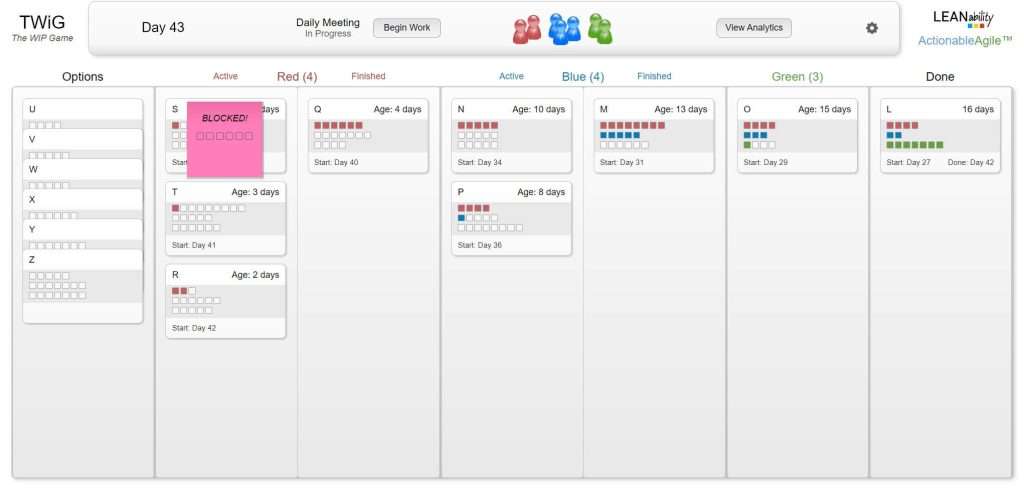
Our top pick online is TWIG: The WIP Game. It lets you tinker with a Kanban flow and watch how your decisions affect the work items. It is a quick way to turn theory into practice and see how the parts interact in a live workflow.
Physical Kanban games bring something different. You have to calculate the metrics and draw the charts yourself, which often reveals insights that an automated tool glosses over. Our favourites:
- GetKanban board game. Focuses on flow, bottlenecks and continuous improvement. A team experience and a great learning tool.
- Featureban. Aimed at software teams. Teaches you to visualise work and manage flow.
- TWIG: The WIP Game, physical version. The same ideas as the online version, ideal for team workshops.
- Kanban Pizza Game. Simulates a pizza kitchen. A fun way to grasp WIP limits and cycle time.
Each one helps you understand how WIP limits and bottlenecks behave in practice.
In summary
In the spirit of The Princess Bride, make sure you know what you mean when you say Kanban, Scrum or Agile. Re-examine your assumptions and keep learning by doing.
We have covered the red flags of an incomplete adoption, the core practices, and the metrics and charts that matter. Learning Kanban is not just reading about it. Try TWIG to experiment with a live workflow, or run a physical game such as GetKanban or Featureban and draw the charts yourself.
If you want to go further, our Mastering Kanban lab lets you run the simulations, build your own board and forecast with your own data.
Go deeper
Mastering Kanban
Put this into practice with the course that covers it in depth.
View the course